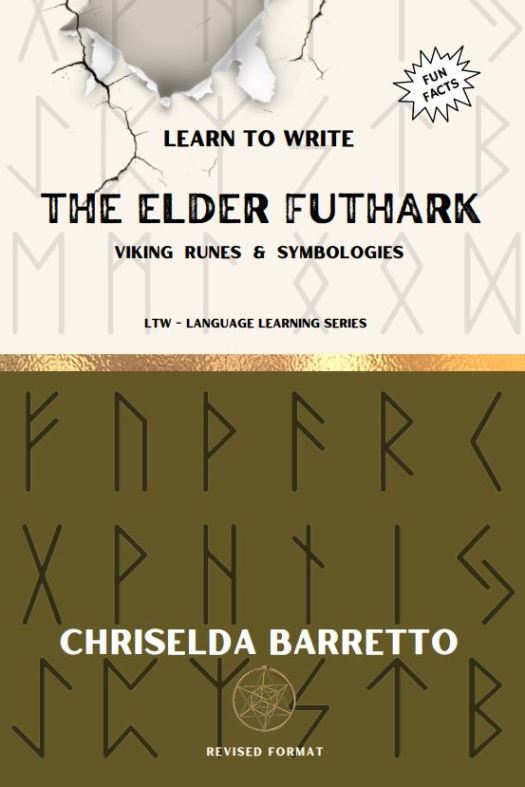
Also known as the Older Futhark, Old Futhark, or Germanic Futhark, the Elder Futhark is the oldest form of the runic alphabets.
It was a writing system used by Germanic peoples for Northwest Germanic dialects in the Migration Period. Inscriptions are found on artifacts including jewelry, amulets, plate ware, tools, and weapons, as well as runestones in Scandinavia, from the 2nd to the 10th centuries.
According to Norse mythology, the runes weren’t invented but rather given to Odin as a divine gift, after he sacrificed himself by hanging from a tree for 9 days and nights.
Introduced in the 20th century, Neo-Tifinagh is a modern alphabetical derivative of the traditional script. It is an abjad script used to write the Berber languages. Tifinagh is believed to be a descendant of the ancient Libyan script.
The Tifinagh alphabet (“Lybico-berber”) has been used by the Berber speaking people in North Africa and the Canary Islands at least from the third century B.C. up to the third century A.D.
Modern standard writing direction is left-to-right, however earlier inscriptions are known to be from right-to-left, and sometimes vertically from bottom-to-top. The letters illustrated here are the IRCAM version of Neo-Tifinagh.













 Chriselda Barretto